Investment Income Tracked Easily
Interactive Brokers provides a huge amount of information about your portfolio, but answering a seemingly simple question can still be surprisingly difficult:
How much income has my portfolio actually generated?
If you receive dividends, earn interest on cash and occasionally sell investments for a profit or loss, the answer may be spread across several different sections of your Interactive Brokers Activity Statement.
Fortunately, IBKR allows you to export this information as a CSV file.
In this guide, we’ll look at the main types of investment returns you can find in an Interactive Brokers (IBKR) Activity Statement CSV, how they differ, and how you can turn the raw brokerage data into a clearer picture of your portfolio income.
Quick answer: Export an IBKR Activity Statement as CSV and review its dividend, withholding-tax, interest and realized profit-and-loss information. If you want to avoid manually processing the file, you can analyze it using the free MoneyFinal Interactive Brokers Income Tracker.
Analyze your IBKR CSV with the MoneyFinal Interactive Brokers Income Tracker →
First: What Do We Mean by Investment Income?
The term investment income can mean different things depending on whether you are talking about portfolio analysis, accounting or taxation.
For the purposes of this guide, it is useful to separate your portfolio returns into several categories.
Dividend income is cash distributed by stocks, ETFs and other investments you own.
Interest income can include interest credited to your brokerage account.
Realized profit or loss results from closing an investment position for more or less than its relevant cost basis.
Unrealized profit or loss represents changes in the value of investments you still own.
These categories should not automatically be treated as equivalent for tax purposes.
For example, a €100 dividend, €100 of interest and a €100 realized capital gain may all increase your wealth, but their tax treatment can be completely different.
This article therefore focuses on portfolio analysis rather than tax calculation.
Step 1: Export Your IBKR Activity Statement as CSV
Before you can analyze your investment income, you need your Interactive Brokers data.
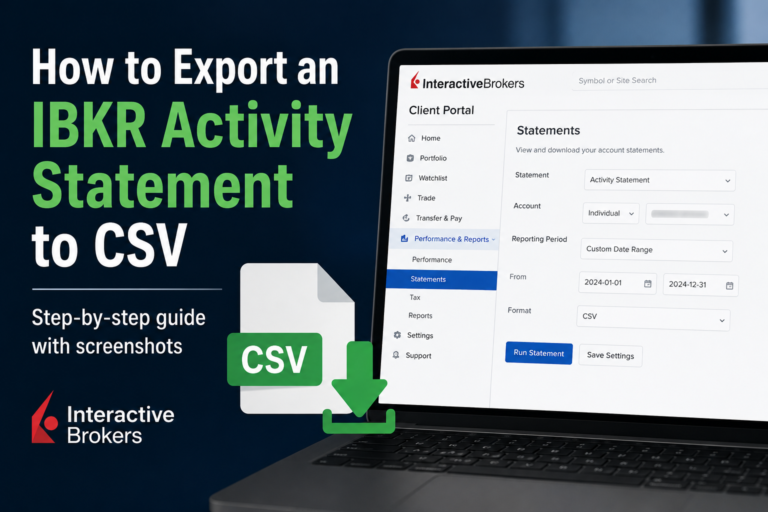
In the IBKR Client Portal, navigate to:
Performance & Reports → Statements
Choose an Activity Statement covering the period you want to analyze and select CSV as the output format.
You might choose an entire calendar year if you want to calculate annual investment income, or a shorter custom period if you are reviewing a particular month or quarter.
If you haven’t done this before, we have a complete walkthrough:
How to Export an IBKR Activity Statement to CSV
Once the file has been downloaded, keep the original CSV unchanged if possible.
Spreadsheet applications can sometimes modify dates, formatting or other values when a CSV is opened and saved again.
Understanding an IBKR Activity Statement CSV
An IBKR Activity Statement CSV is not necessarily structured like a simple spreadsheet containing one transaction per row.
Instead, it can contain multiple sections covering different types of account activity.
That is important because calculating portfolio income isn’t simply a matter of adding every positive number in the file.
You need to identify what each amount represents.
For an income-focused investor, four particularly useful areas are:
- dividends and related withholding tax;
- interest;
- realized profit and loss; and
- currency information.
Let’s look at each one separately.
1. Calculate Your Dividend Income
For many long-term investors, dividends are the most obvious form of portfolio income.
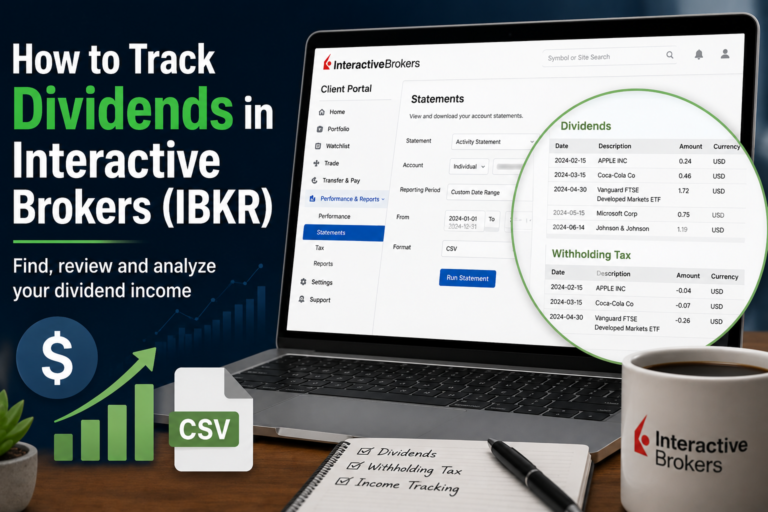
Your IBKR Activity Statement can contain dividend transactions showing distributions credited to your account during the selected period.
If you want to calculate your gross dividend income, the basic idea is to identify all qualifying dividend transactions for the period and total their amounts.
For example, if your portfolio produced several dividend payments throughout the year, their combined value represents your gross dividend income before considering related withholding tax.
Don’t Forget Dividend Withholding Tax
The amount declared as a dividend by a company isn’t necessarily the amount you ultimately retain.
Foreign dividends in particular may have tax withheld before the money reaches your account.
Therefore, it is useful to distinguish between:
Gross dividend income
and
Net dividend income after withholding tax
Conceptually:
Gross dividends − dividend withholding tax = net dividend cash received
This is especially relevant for international investors who own securities domiciled in several different countries.
Interactive Brokers reporting can show both dividend activity and associated withholding-tax information.
If dividends are an important part of your portfolio strategy, see our dedicated guide:
How to Track Dividends in Interactive Brokers (IBKR)
2. Calculate Interest Income
Dividends aren’t the only source of investment income that may appear in an Interactive Brokers account.
Depending on your account, balances and activity, your statement may also contain interest received or credited.
For example, an investor may hold cash while waiting for an investment opportunity and receive interest on an eligible balance.
When analyzing your portfolio, it can therefore be useful to keep interest separate from dividends.
A simple portfolio-income breakdown might show:
Dividend income: income generated by securities.
Interest income: income associated with eligible cash or other interest-producing account activity.
Keeping them separate gives you much more information than simply reporting one combined income number.
It also allows you to understand where your portfolio returns are coming from.
3. Understand Realized Profit and Loss
Realized profit and loss is different from dividend or interest income.
Suppose you bought an investment and later sold it for more than its relevant cost basis.
The resulting gain may appear as realized profit.
Likewise, selling below the relevant cost basis can produce a realized loss.
Realized P&L can therefore be useful when answering a broader question such as:
How much did my closed investment activity contribute to my portfolio results during this period?
However, you should avoid treating realized gains as identical to dividends.
A dividend is a cash distribution generated while you continue to own an investment.
A realized gain generally arises because you disposed of some or all of an investment position.
For portfolio analysis, both can be useful. But they represent different sources of return.
Realized P&L vs Unrealized P&L
This distinction is particularly important.
Imagine that you bought a stock for €1,000 and it is currently worth €1,300.
You have an unrealized gain of €300.
But if you still own the stock, you haven’t realized that gain by selling the position.
If you subsequently sell it and the applicable calculation produces a €300 gain, that amount becomes realized.
Therefore:
Unrealized P&L reflects movements in the value of open investments.
Realized P&L relates to investment positions that have been closed or reduced.
If your goal is to calculate cash-generating or realized portfolio activity, blindly adding unrealized gains to dividend and interest income can give you a misleading result.
A More Useful Way to Measure IBKR Portfolio Income
Instead of trying to create one enormous number, consider separating your results into categories.
For example, an income dashboard can show dividend income separately from interest income and realized trading results.
This tells you much more about your portfolio.
Two investors could both generate €5,000 of positive portfolio results, but those results might look completely different.
One investor might receive most of the amount from recurring dividends.
Another might generate most of it from selling investments at a profit.
Those portfolios have very different income characteristics even though the headline number could appear similar.
For an investor focused on building recurring investment income, understanding that distinction is particularly important.
What About Deposits and Withdrawals?
Depositing money into your Interactive Brokers account is not investment income.
Likewise, withdrawing money from the account doesn’t necessarily represent an investment loss.
These are cash flows between you and your brokerage account.
If you deposit €5,000 and your brokerage balance increases by €5,000, your portfolio hasn’t suddenly generated €5,000 of investment income.
This sounds obvious, but it becomes important when working with raw transaction data because deposits, withdrawals, investment income and trading activity can all appear inside the same broader Activity Statement.
A proper income calculation should therefore distinguish portfolio-generated returns from external cash flows.
Watch Out for Multiple Currencies
Interactive Brokers is popular with investors who hold securities from several countries.
As a result, your statement may contain transactions denominated in currencies such as USD, EUR, GBP, CHF and others.
This creates a simple mathematical problem:
You cannot meaningfully calculate:
$100 + €100 + £100 = 300
without deciding how those currencies should be converted.
When analyzing an international portfolio, you therefore need to understand whether a particular number represents the original transaction currency or an amount converted into your account’s base currency.
Currency movements can also affect the value of investments independently of the underlying investment’s performance.
For this reason, currency handling should be considered carefully whenever you combine income from multiple markets.
Manual IBKR CSV Analysis vs an Automated Tracker
You can analyze an IBKR CSV manually.
A spreadsheet application allows you to inspect the relevant sections, filter transactions, total amounts and build your own calculations.
For a simple portfolio, this may be perfectly sufficient.
The difficulty increases as you accumulate:
more securities, more dividend payments, multiple currencies, interest transactions, sales, withholding taxes and several years of data.
At that point, repeatedly processing Activity Statements manually becomes time-consuming.
This is the problem the MoneyFinal Interactive Brokers Income Tracker is designed to simplify.
Analyze Your IBKR CSV with MoneyFinal
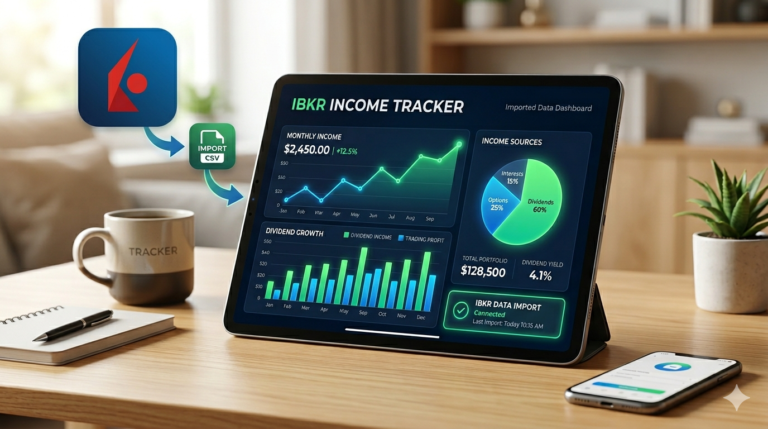
The MoneyFinal Interactive Brokers Income Tracker is designed to turn information from an IBKR Activity Statement CSV into a more understandable investment-income overview.
Open the free Interactive Brokers Income Tracker →
Rather than manually searching through a long CSV file, you can use the tracker to help review the income-related information contained in your statement.
Depending on the activity contained in your file, this can make it easier to understand areas such as dividend income, interest income and realized investment results.
The goal isn’t to replace Interactive Brokers’ official reporting.
Instead, MoneyFinal provides an additional way to visualize and understand the data that IBKR already provides.
Privacy and Your IBKR CSV
An Interactive Brokers Activity Statement can contain sensitive financial information.
You should therefore treat it like any other financial document.
Before uploading a brokerage statement to any third-party service, understand how the service handles your data and whether the file is transmitted to a remote server.
It is important to note that the IBKR Income Tracker does not upload or save online any of the information it processes from the CSV file that you upload to the tracker.
You should also avoid publishing or sharing screenshots containing account numbers, personal details or other sensitive information.
Is This the Same as Calculating Your Taxable Income?
No.
This distinction is extremely important.
A portfolio-income tracker can help you understand information such as dividends, interest and realized investment results.
It does not determine your personal taxable income.
Tax rules depend on factors such as your country of residence, type of investment, account structure, security domicile and personal circumstances.
Different jurisdictions may also classify dividends, interest, capital gains and payments in lieu differently.
If you’re calculating figures for a tax return, use the relevant official tax documentation and seek professional advice where necessary.
Why Track Investment Income Over Time?
Calculating one year’s investment income is useful.
Tracking it consistently can be much more valuable.
Over time, you can begin answering questions such as:
Is my dividend income growing?
How much of my portfolio return comes from recurring distributions?
How much interest is my idle cash generating?
Which investments contribute most to my income?
How dependent are my results on realized trading gains?
How much withholding tax is reducing my gross dividends?
Those questions provide considerably more insight than simply looking at your current portfolio value.
For an income-focused investor, they can also help illustrate whether the portfolio is gradually becoming a larger source of recurring cash flow.
Frequently Asked Questions
Can I calculate investment income from an IBKR CSV?
Yes. Interactive Brokers Activity Statements can contain information including dividends, interest, transactions and profit-and-loss data.
Exporting an Activity Statement as CSV allows that information to be analyzed using spreadsheet software or a compatible portfolio-analysis tool.
Can I calculate my IBKR dividend income from a CSV?
Yes.
Dividend transactions contained in your Activity Statement can be used to analyze the dividends credited during a selected period.
You should also consider associated withholding tax if you want to distinguish between gross and net dividend income.
Does IBKR CSV data include interest?
Activity Statements can contain interest-related account activity.
The exact sections present in your statement depend on your account and activity during the selected period.
Should I include unrealized gains as investment income?
Not automatically.
Unrealized P&L represents changes in the value of investments you still hold.
For an analysis focused on realized portfolio activity or cash income, it generally makes sense to display unrealized gains separately rather than combining them directly with dividends and interest.
Are deposits into my IBKR account investment income?
No.
A deposit is an external cash flow into the account rather than income generated by the portfolio.
Can I combine IBKR income from different currencies?
You can, but the currencies need to be handled consistently.
Make sure you understand whether the amounts you are analyzing are shown in their original currencies or converted into a common/base currency before combining them.
Can MoneyFinal calculate my taxes from an IBKR CSV?
No.
The MoneyFinal Income Tracker is intended for portfolio and investment-income analysis, not personal tax calculation.
Tax treatment varies between investors and jurisdictions.
Turn Your IBKR Statement into a Clearer Income Overview
An Interactive Brokers Activity Statement contains far more information than a single portfolio-income number can express.
The key is to separate the different components.
Dividend income tells you how much cash your investments distributed.
Interest shows income generated from relevant interest-bearing account activity.
Realized P&L helps you understand the result of investment positions you actually closed or reduced.
Unrealized P&L shows movements in investments you continue to own.
Deposits and withdrawals represent external cash flows rather than portfolio-generated income.
Once you understand these distinctions, your IBKR Activity Statement becomes much easier to analyze.
And if you don’t want to process all of that information manually, you can use the free MoneyFinal tool:
Analyze your IBKR Activity Statement with the MoneyFinal Interactive Brokers Income Tracker →
Continue Your IBKR Income Tracking Setup
Need to download your statement first?
How to Export an IBKR Activity Statement to CSV
Want to focus specifically on dividend income?
How to Track Dividends in Interactive Brokers (IBKR)
For the broader guide:
Mastering IBKR Income Tracking
MoneyFinal is an independent financial-tools website and is not affiliated with Interactive Brokers. This content is provided for educational and informational purposes only and does not constitute financial, investment or tax advice. Interactive Brokers and IBKR are trademarks of their respective owners.